

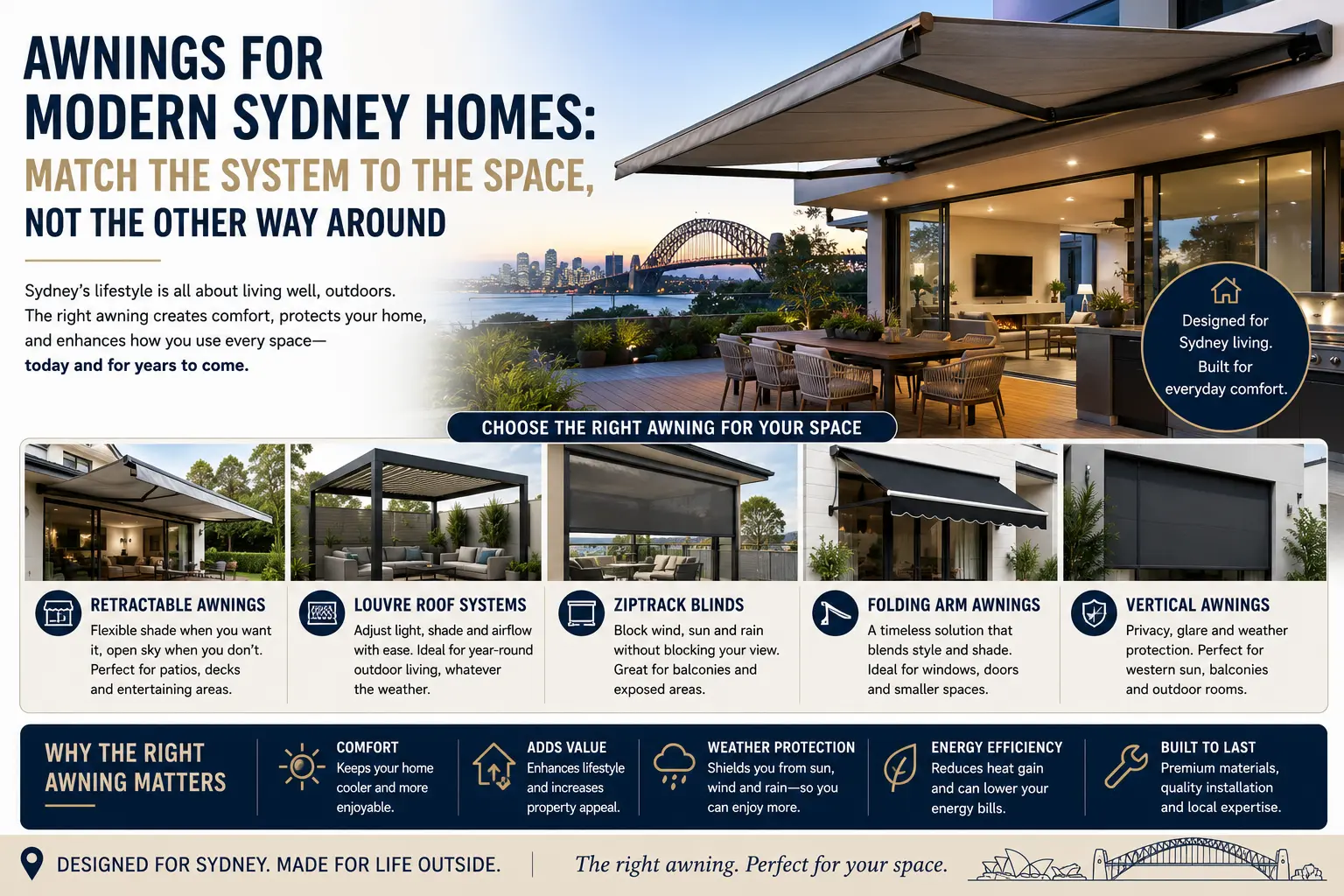
There’s a particular point in a Sydney renovation when the house starts to feel almost right, but one part still doesn’t quite work. The living room gets too bright in the afternoon. The balcony is beautiful but rarely comfortable. Or the new outdoor area looks fantastic until summer arrives. These aren’t necessarily design failures, but possibly lack of a critical addition; awnings that simply create a better response to your surroundings. That is where thoughtful shading earns its place.
1. Retractable, Fixed or Adjustable Awnings?
When choosing an overhang covering, before you consider the fabric, focus on how the structure actually functions.
- The set-it-and-forget-it nature of a fixed frame
- The on-demand shade of a retractable unit
- The precision weather management of an adjustable louvered system
- Your choice dictates how your space responds to wind, rain, and changing sunlight throughout the year.
For example: Take a living room facing west. At 10am, the windows may be perfectly comfortable. By late afternoon, low sunlight can turn the same room into a glare-filled space. A fixed solution might help, but it could also block useful light at other times.
This is where awnings Sydney professionals turn a frustrating sun problem into an effortless, tailored solution:
- Retractable systems suit spaces where shade is needed at certain times but an open sky is desirable at others.
- Fixed awnings make more sense when consistent protection is the priority.
- Adjustable systems offer more control when the sun angle changes significantly throughout the day.
The right choice often becomes obvious once the home’s daily rhythm is understood. A specialist isn’t simply asking where you want an awning. They’re looking at when the problem occurs, what causes it, and how much control you actually need.
2. Material Isn’t Just a Finish, It Changes How the Awning Lives
Two awnings may look identical on “day one” but diverge over time. That narrows down to durability, weathering, and long-term performance, which are driven entirely by materials, not just surface finishes.
Sydney’s combination of diverse weather demands material selection worth more thought than simply matching a color to the façade.
- A contemporary home with clean architectural lines may suit powder-coated aluminum particularly well.
- A renovated character property might benefit from a fabric awning that feels less visually heavy.
- In a coastal setting, the conversation shifts toward corrosion resistance and the long-term behavior of exposed components.
Good material selection considers:
- Appearance: Does the system belong with the existing architecture?
- Durability: How will it handle the home’s particular exposure?
- Maintenance: What will ownership actually look like after installation?
- Performance: Will the material provide the shade and comfort the space requires?
Professional installations avoid the awning appear like something added afterwards, but as a natural inclusion.
3. Placement Can Matter More Than the Size of the Awning
It is easy to assume that a bigger awning solves a bigger shading problem. It doesn’t always. If the afternoon sun is entering at a low angle, adding more overhead coverage may not address the glare coming through the side of a window. Likewise, covering a beautifully positioned outdoor area can create unnecessary darkness inside if the design hasn’t been considered carefully.
Consider a few different situations. A west-facing family room may need protection from late-day sun. A balcony might need shade without losing the view. A poolside entertaining area may benefit from broad coverage, while a narrow terrace could require a more compact solution.
Before specifying anything, a competent installer should be looking at:
- Window orientation and the movement of the sun.
- Where people actually sit, eat, work, or entertain.
- Wind exposure and available structural fixing points.
- Existing rooflines, windows, doors, and architectural features.
- Views that should remain open rather than being accidentally obstructed.
That level of assessment is what separates a properly designed shading solution from simply fitting an awning into an available wall space. However, for manual retractable patio awnings and awning-style windows, using quality crank handles is crucial for ease of operability.
4. Attenuation, Automation and the Quiet Benefits of Better Shading
For many Sydney homeowners, the real value of an awning becomes apparent after installation.
- The television is easier to see without afternoon glare.
- The outdoor table becomes usable for longer.
- Shading big glass doors stops a room from turning into a greenhouse
- Keeps your floors and furniture from fading.
They aren’t flashy benefits, but they’re usually the ones you appreciate most every single day.
Adding a motor just makes life easier, especially for large or high-up awnings. Being able to extend or retract shade at the touch of a button turns a daily chore into zero effort. Also, sensors can also be useful where changing weather conditions need to be considered. But automation should solve a genuine problem. There’s little value in adding technology simply because it is available.
In essence, when designing your awnings, the more professional approach is to start with the home, not the catalogue. Look at the sun, the architecture, the people using the space, and what the property needs to do better. From there, everything else—the materials, the tilt angle, the coverage, and whether it’s motorized or manual—just falls into place based on how you actually live.
That’s where a true specialist pays for themselves: not by upselling you on the most expensive, gadget-filled awning on the market, but by knowing when a simpler, perfectly tailored solution will make your home feel better for years to come.
Related posts:
 Selling a Home in Kennington: What Local Sellers Should Know
 What to Know Before Buying or Selling Property in Hackney
 How to Reface Kitchen Cabinets
 Easy DIY Door Maintenance Tips to Keep Your Doors Looking Great
 Condensation Crisis: How to Prevent Foggy Windows
 Strength and Precision: The Backbone of Modern Industry and Home Improvement
 Where to Use White Hygienic Cladding Throughout the Home